
Making a Will is one of the most practical things you can do for your family. Yet most people put it off — assuming the law will take care of things, or that it is only something to think about later in life. In reality, dying without a Will can leave your family facing delays, conflict, and financial consequences that are entirely avoidable.
Here are three reasons why a Will matters more than you might think.
Your estate needs someone you trust to manage it
When you die, someone has to collect your assets, pay your debts, and distribute what remains to your family. A Will lets you appoint an executor — someone you trust to carry out your wishes properly.
Without a Will, the law decides who steps in. That person is usually a close family member who is also a beneficiary — which creates an immediate tension. The law refers to that person as an administrator. They have both a personal interest in the estate and the legal authority to manage it. A solicitor cannot refuse an administrator’s instruction to transfer assets into their administrator account for distributions: they are legally entitled to do so, often with the entirely reasonable justification of saving legal costs.
A well-drafted Will names not just an executor, but a substitute executor — so that if your first choice is unable or unwilling to act, someone you trust is still in place. This single provision can prevent significant conflict within a family at one of its most difficult moments.
Your chosen beneficiaries may not inherit
Many people assume their estate will pass to their family automatically — and under the intestacy rules, that is broadly true. But intestacy rules follow a fixed order, and they cannot account for your personal circumstances.
What if a beneficiary under the intestacy rules dies before you? What if your family structure has changed through remarriage, estrangement, or a new relationship? Without a Will, there is no fallback. Your estate may pass to someone you would not have chosen, or become subject to a lengthy and costly legal process.
A Will lets you name the people you want to benefit — and, critically, name substitutes if they predecease you. It puts you in control, not the law.
You may lose valuable tax relief without realising it
If your estate exceeds the nil-rate band — currently £325,000 — inheritance tax becomes a real consideration. A Will is your primary tool for managing this.
One of the most valuable reliefs available is the spousal exemption: assets passing to a spouse or civil partner on death are generally free from inheritance tax. Without a Will, assets may pass differently under the intestacy rules — potentially to children rather than your spouse — which could consume your nil-rate band unnecessarily at the first death between a couple.
That matters for two reasons. First, any nil-rate band used at your death cannot be transferred to your surviving spouse. Second, if the nil-rate band increases between your death and your spouse's, an unused allowance at your death preserves the possibility of your spouse benefiting from the higher figure when it is eventually transferred. Use it up unnecessarily, and that opportunity is gone. The image below illustrates the difference:
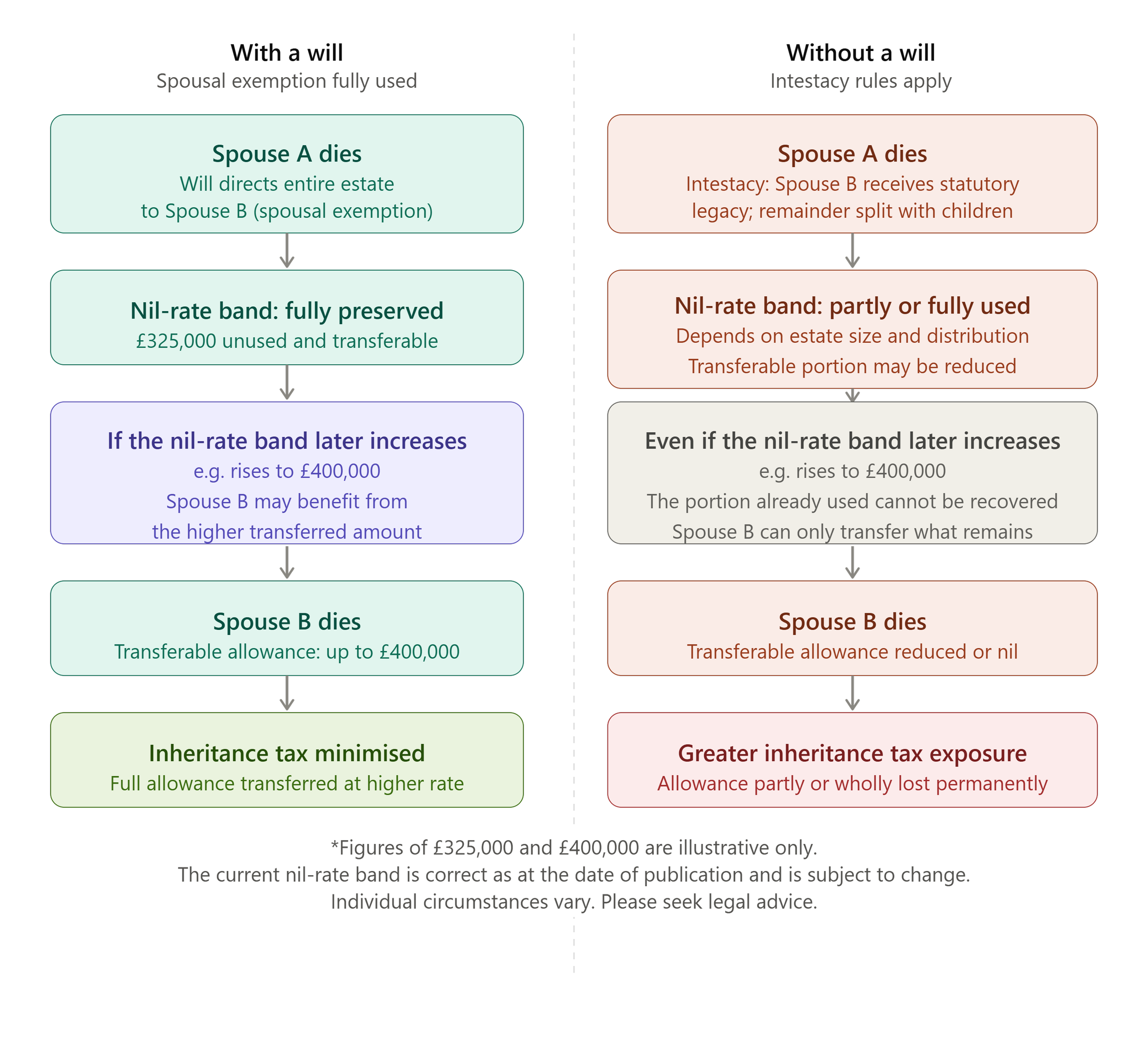
With a will vs without a will: what happens to your nil-rate band
A well-drafted Will ensures the spousal exemption works where it delivers most benefit — and keeps your nil-rate band intact for your surviving spouse.
For a closer look at how the spousal exemption works in practice, see another guide: The Spousal Exemption and Your Will.
Final words: making a Will is not a morbid exercise. It is one of the clearest expressions of care for the people who matter most — and one of the most straightforward steps you can take to protect them.
This article is general information only and does not constitute legal or tax advice. On Yin Li Solicitor is regulated by the SRA (SRA number 8006709) and provides Will and Lasting Power of Attorney services only; this practice does not offer standalone lifetime tax planning advice. Please get in touch to discuss your individual circumstances. All rights reserved.